


 Posts
Posts


- Looking back on the ‘00s: A look at how social media changed reporting over the past decade.
- Rock star PR move – January edition: Grand Forks turned a printing error into a well-placed plug for the area.
- The reality disconnect in American politics: New evidence: Chris Georgacas predicted that 2010 will be an anti-incumbent and anti-establishment year.
- Newspapers rethink Internet anonymity: Newspapers debated about regulating online comments.
- The ultimate retweet: The Library of Congress archived all public tweets.
- A lesson in journalistic ethics: A reporter outed an openly gay senior pastor in the Minnesota-based magazine Lavender.
- Putting the hyper in hyper-local news: Community-specific websites battled mainstream media to cover the suburbs.
Showing posts with label politics. Show all posts
Showing posts with label politics. Show all posts
Monday, December 27, 2010
The best of The GH Spin
For many media outlets, New Years is an excuse to reminisce about the previous year and create hundreds of lists announcing the top stories, events, and people of the year. At The GH Spin, we agree – it just wouldn’t be New Years if we didn’t have a “best of” list. Here are some of our top blogs from 2010:


Friday, November 5, 2010
Chris Georgacas named top political influencer
Goff & Howard President Chris Georgacas was recently named one of Minnesota’s top political influencers by Campaigns and Elections magazine. On the list, he joins Saint Paul Mayor Chris Coleman, Congressman Erik Paulsen, former U.S. Vice President Walter Mondale, and others.
Chris is widely regarded as one of Minnesota’s top public affairs strategists. He has been involved in Minnesota government, civic affairs, and politics for more than three decades, including serving two terms (from 1993-1997) as state chairman of the Republican Party of Minnesota. Earlier this year, the Republican Party honored Chris with a Lifetime Achievement Award. Following a transition of leadership in the Emmer campaign, Chris became chairman and helped Tom Emmer become highly competitive in Minnesota’s gubernatorial race.
Congratulations to Chris on this well-deserved honor.
Chris is widely regarded as one of Minnesota’s top public affairs strategists. He has been involved in Minnesota government, civic affairs, and politics for more than three decades, including serving two terms (from 1993-1997) as state chairman of the Republican Party of Minnesota. Earlier this year, the Republican Party honored Chris with a Lifetime Achievement Award. Following a transition of leadership in the Emmer campaign, Chris became chairman and helped Tom Emmer become highly competitive in Minnesota’s gubernatorial race.
Congratulations to Chris on this well-deserved honor.
Thursday, July 15, 2010
Blue Cross Blue Shield celebrates employees’ involvement in government and politics
Employees are not often given the opportunity to spend the lunch hour learning about government and politics, but at Blue Cross Blue Shield, they have been doing exactly that for the last 10 years. Blue Cross has made it a priority to provide employees opportunities to participate in meaningful civic engagement activities through its CitizenBlue program.
The award-winning civic engagement program has served as a model for other companies striving to educate employees about the political system and encourage participation in government at all levels.
We have enjoyed helping Blue Cross Blue Shield shape and grow the program from the beginning. Congratulations on 10 years of success.
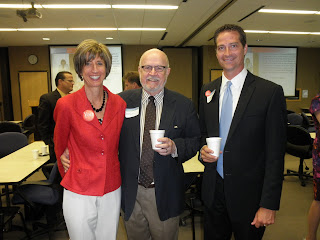
Goff & Howard’s Bob Goff joins Blue Cross Blue Shield officials
Kathy Mock, senior vice president of public and health affairs,
and Phil Stalboerger, vice president of policy and legislative affairs,
at CitizenBlue’s 10th anniversary celebration.
Tuesday, May 4, 2010
The ever-changing meaning of change
The Pew Research Center for the People & the Press just released a new study that tests Americans’ reactions to words and phrases that are used frequently in political conversations: “capitalism,” “civil liberties,” “civil rights,” “family values,” “libertarian,” “militia,” “progressive,” “socialism,” and “states’ rights.”
Here are the results, so look away now if you want to rank the words yourself from most positive to least positive impression.
But one word is conspicuously absent from the survey. It is perhaps the most used – or overused – word in politics: “change.” It was spoken so frequently during the last Presidential election that it became part of an Obama speech drinking game.
The word “change” also illustrates well that people’s reactions differ depending on who you ask and when you ask. “Change” generally has more positive connotations with younger people than older people, according to a February 2010 Pew study. During the 2008 elections, most voters would have probably said that change in American politics primarily meant a break from political leaders of the past. Those same voters today might instead associate political change with transforming Wall Street and corporate leadership.
Before the politicians of 2010 become overly fond of using any particular words, I hope they consider that words and connotations are ever-changing. If there is a politician out there who wants to talk semantics strategy, I’m all ears.
Here are the results, so look away now if you want to rank the words yourself from most positive to least positive impression.
1. Family Values: 89% positive/9% negativeAs expected, Democrats and Republicans differed in their reactions. Democrats were more favorable than Republicans to “civil liberties,” “civil rights,” “libertarian,” “progressive,” and “socialism.” Republicans responded more positively than Democrats to “capitalism,” “family values,” “militia,” and “states’ rights.”
2. Civil rights: 87%/10%
3. Civil liberties: 76%/14%
4. States rights: 77%/15%
5. Progressive: 68%/23%
6. Capitalism: 52%/37%
7. Libertarian: 38%/37%
8. Socialism: 29%/59%
9. Militia: 21%/65%
But one word is conspicuously absent from the survey. It is perhaps the most used – or overused – word in politics: “change.” It was spoken so frequently during the last Presidential election that it became part of an Obama speech drinking game.
The word “change” also illustrates well that people’s reactions differ depending on who you ask and when you ask. “Change” generally has more positive connotations with younger people than older people, according to a February 2010 Pew study. During the 2008 elections, most voters would have probably said that change in American politics primarily meant a break from political leaders of the past. Those same voters today might instead associate political change with transforming Wall Street and corporate leadership.
Before the politicians of 2010 become overly fond of using any particular words, I hope they consider that words and connotations are ever-changing. If there is a politician out there who wants to talk semantics strategy, I’m all ears.
Wednesday, April 28, 2010
Pentagon PowerPoint enemy: You read it here before you saw it in the mainstream media
A month and a half ago, I noted the PowerPoint slide cognitive corruption which passes for Pentagon thinking about the interconnectedness of military operations and political “affairs” in the war in Afghanistan.
Yesterday’s New York Times and today’s Daily Mail (UK) now have stories about it.
Just remember: In the world of communications, come to The GH Spin before “the Gray Lady.”
Those who have studied Edward Tufte will smile when reading the British article’s statement: “PowerPoint has become public enemy number one for many US officers who find themselves battling slide presentations rather than insurgents.”
Yesterday’s New York Times and today’s Daily Mail (UK) now have stories about it.
Just remember: In the world of communications, come to The GH Spin before “the Gray Lady.”
Those who have studied Edward Tufte will smile when reading the British article’s statement: “PowerPoint has become public enemy number one for many US officers who find themselves battling slide presentations rather than insurgents.”
Wednesday, March 24, 2010
The reality disconnect in American politics: new evidence
Some of my Republican friends have been unhappy with me lately because I’ve cautioned that this could become not so much an anti-Democratic year, but an anti-incumbent and anti-establishment one.
Pollster Scott Rasmussen’s latest Rasmussen Reports survey of public attitudes about Congress illustrates what is brewing. While Americans have been giving Congress historically low approval ratings for the past two and a half years – typically in the low teens – Rasmussen has found in recent months that a supermajority of Americans give Congress a “poor” rating – 71% in February and 64% in a new survey released this week. Of course, Americans love to bash the stupidities of Congress. From Mark Twain and H. L. Mencken to late-night comedians, political satire has been a staple of our popular culture. But voters’ attitudes seem to be moving from bemused (or fatalistic) resignation to something edgier.
The most fascinating finding in the Rasmussen survey is this: while a supermajority of Americans overall think Congress is performing “poorly,” 53% of Rasmussen’s group of voters described as the “political class” segment think Congress is doing a “good” or “excellent” job! These are voters who typically trust elites and the intentions and efficacy of government. (They also represent, according to a January 2010 Rasmussen survey, something like only one in ten voters.)
“Political class” voters are likely to work in the media or in the public sector (largely shielded by the convulsions in the private economy), or are active in party politics. They hold a much more sanguine view of the state of current affairs than do perhaps 90% of their fellow citizens.
When cultural elites and their fellow travelers hold widely divergent (and far more optimistic) views from the rest of society in a time of economic crisis, incendiary things can happen.
Pollster Scott Rasmussen’s latest Rasmussen Reports survey of public attitudes about Congress illustrates what is brewing. While Americans have been giving Congress historically low approval ratings for the past two and a half years – typically in the low teens – Rasmussen has found in recent months that a supermajority of Americans give Congress a “poor” rating – 71% in February and 64% in a new survey released this week. Of course, Americans love to bash the stupidities of Congress. From Mark Twain and H. L. Mencken to late-night comedians, political satire has been a staple of our popular culture. But voters’ attitudes seem to be moving from bemused (or fatalistic) resignation to something edgier.
The most fascinating finding in the Rasmussen survey is this: while a supermajority of Americans overall think Congress is performing “poorly,” 53% of Rasmussen’s group of voters described as the “political class” segment think Congress is doing a “good” or “excellent” job! These are voters who typically trust elites and the intentions and efficacy of government. (They also represent, according to a January 2010 Rasmussen survey, something like only one in ten voters.)
“Political class” voters are likely to work in the media or in the public sector (largely shielded by the convulsions in the private economy), or are active in party politics. They hold a much more sanguine view of the state of current affairs than do perhaps 90% of their fellow citizens.
When cultural elites and their fellow travelers hold widely divergent (and far more optimistic) views from the rest of society in a time of economic crisis, incendiary things can happen.
Tuesday, March 23, 2010
Health care debate goes viral
Drama unfolded on Sunday as the health care reform debate jumped from Capitol Hill to television, computer, and cell phone screens across the nation. On a weekend traditionally dominated by NCAA basketball coverage, it is hard to believe that C-SPAN, FOX News, MSNBC, and CNN ratings were through the roof as many Americans skipped March Madness to watch the cable news networks’ live coverage of the U.S. House of Representatives health care reform debate.
Social networking sites were also buzzing with lively debates as friends commented on statuses and posted links to coverage. At 9 p.m. on Sunday – when the House passed the health care bill – 2.05% of tweets included the health care reform hash tag (#hcr). While initially this figure might not seem significant, when Tiger Woods announced his return to the Masters on March 16, only 0.062% of tweets mentioned Tiger.
Over the past few months, it’s been fun to follow tweets about the Super Bowl, the Oscars, and the Bachelor, but this most recent trending topic could be downright inspiring. At a time when many people lament the demise of the media’s ability to inform the public, millions of people are receiving more information and sharing their opinions about important political issues than ever before through Twitter and Facebook. Social networking has quickly become the fastest growing method of civic engagement – a trend I hope sticks around for good.
Social networking sites were also buzzing with lively debates as friends commented on statuses and posted links to coverage. At 9 p.m. on Sunday – when the House passed the health care bill – 2.05% of tweets included the health care reform hash tag (#hcr). While initially this figure might not seem significant, when Tiger Woods announced his return to the Masters on March 16, only 0.062% of tweets mentioned Tiger.
Over the past few months, it’s been fun to follow tweets about the Super Bowl, the Oscars, and the Bachelor, but this most recent trending topic could be downright inspiring. At a time when many people lament the demise of the media’s ability to inform the public, millions of people are receiving more information and sharing their opinions about important political issues than ever before through Twitter and Facebook. Social networking has quickly become the fastest growing method of civic engagement – a trend I hope sticks around for good.
Friday, March 12, 2010
The college kid in every legislator
Reading piles of papers you neglected when they were assigned, meeting frantically with study groups, pulling all-nighters – are you thinking of your college days yet? This week the inner college student in legislators seems to have emerged due to today’s first committee deadline.
All week committee hearings have stretched from early in the morning until late at night to accommodate the last-minute bills that still need to be approved by policy committees in order to be considered during the remainder of the session. Some legislators have even pulled all-nighters to keep up with the influx of bills that arrive in their offices.
Today is the time for legislators to fish or cut bait.
Wednesday, March 10, 2010
The Afghan troop surge meets Pentagon chartjunk
Edward Tufte coined the term chartjunk in his 1983 classic, The Visual Display of Quantitative Information, to describe elements which “make the graphic appear more scientific and precise” than the data needs or allows. In government, chartjunk is regularly used by bureaucratic elites to justify their unique grasp of a perilous situation. But so often, it is also a graphic confession of confusion or bad thinking.
Take this recent example:

Afghan society is often characterized as a tangled web of tribal, religious, ethnic, economic, and other alliances. The U.S. Department of Defense visualizes the Obama troop surge in that difficult land as a similar tangle of programs, initiatives, and “stakeholders.”
Perhaps Alexander the Great, the Persians, the British Raj, and the Soviet army didn’t have enough flowcharts.
Take this recent example:

Afghan society is often characterized as a tangled web of tribal, religious, ethnic, economic, and other alliances. The U.S. Department of Defense visualizes the Obama troop surge in that difficult land as a similar tangle of programs, initiatives, and “stakeholders.”
Perhaps Alexander the Great, the Persians, the British Raj, and the Soviet army didn’t have enough flowcharts.
Monday, March 8, 2010
Minnesota’s indebtedness ranks in the middle of the 50 states
The orgy of public sector spending across the globe in recent years is coming home to roost. Speculation is now running rampant that the PIIGS (Portugal , Italy , Ireland , Greece and Spain
For years, observers of state governments have closely watched the deteriorating fiscal conditions of most of the 50 state governments. But with the heightened awareness of global sovereign debt, more scrutiny is being paid to each state’s indebtedness. As part of its new survey on “The Global Debt Bomb,” Forbes conducted an overview of the states’ debt problems. The five best ranked states were Utah (1), New Hampshire (2), Nebraska (3), Texas (4), and Virginia (5). The five worst ranked were, not surprisingly,
Subscribe to:
Posts (Atom)